
Quick Answer
Fatty liver disease occurs when excess fat — more than 5% of the organ’s weight — accumulates inside liver cells. In most Indians it is caused by a high-carbohydrate diet, sedentary habits, or metabolic conditions like diabetes and obesity. Grade 1 and Grade 2 are fully reversible with lifestyle changes alone. Grade 3 requires medical supervision, and Grade 4 (cirrhosis) demands specialist treatment without delay.
What Is Fatty Liver Disease?
Your liver is not supposed to store fat. It processes nutrients, filters toxins, produces bile, and regulates blood sugar — and it does all of this most efficiently when it is lean. When fat droplets begin collecting inside liver cells, however, the organ slowly loses its ability to function, and a condition called fatty liver disease sets in.
There are two types doctors diagnose:
Non-Alcoholic Fatty Liver Disease (NAFLD) is the most common form in India, affecting people who drink little or no alcohol. It is driven primarily by diet, metabolic health, and genetics.
Non-Alcoholic Steatohepatitis (NASH) is a more aggressive sub-type of NAFLD. Here, the fat accumulation also causes inflammation and progressive liver cell damage. Left untreated, NASH can advance to fibrosis, cirrhosis, and, in some cases, liver cancer.
Alcoholic Fatty Liver Disease (AFLD) is directly caused by heavy alcohol consumption and follows a similar progression.
How Common Is Fatty Liver in India?
Fatty liver disease is no longer a “Western” condition. Studies suggest that approximately 30–38% of the Indian population has some degree of NAFLD, with prevalence even higher in urban areas, among people with type 2 diabetes, and in those with central obesity — the kind of belly fat so common in the Indian body type.
What makes this particularly concerning is that India’s NAFLD patients tend to be younger and leaner than their Western counterparts. A person can have a “normal” BMI by Western standards but still carry dangerous amounts of visceral fat around the liver and other organs. This is sometimes called the “thin-fat” Indian phenotype, and it means that slim Indians are not automatically protected.
What Causes Fatty Liver in Indians? The Root Triggers
Understanding the cause is the first step toward reversal. The following factors are the most common drivers in the Indian population:
Diet high in refined carbohydrates. White rice, maida (refined flour), white bread, sugary drinks, and packaged snacks cause rapid spikes in blood sugar. The liver converts excess glucose into fat through a process called de novo lipogenesis, and over time, that fat builds up inside liver cells.
Type 2 diabetes and insulin resistance. When cells stop responding to insulin properly, the liver receives confused hormonal signals and begins storing fat aggressively. India has over 100 million people with diabetes, making this one of the biggest drivers of NAFLD in the country.
Central obesity. Excess fat around the abdomen — even in people of normal body weight — correlates strongly with fat accumulation in the liver.
High triglycerides and low HDL cholesterol. These two lipid abnormalities, very common in Indians eating a traditional high-carb diet, are directly linked to fatty liver.
Sedentary lifestyle. Physical inactivity slows fat metabolism. Without regular movement, the liver cannot efficiently burn the fat it receives from the diet.
Rapid weight loss or crash dieting. Counterintuitively, losing weight too quickly — through starvation or extreme calorie restriction — floods the liver with fatty acids from breaking-down fat tissue, temporarily worsening liver fat.
Genetic factors. Certain gene variants, including the PNPLA3 gene mutation, make Indians disproportionately susceptible to fatty liver even at lower levels of dietary fat intake.
Fatty Liver Grades: What Grade 1, 2, 3 and 4 Actually Mean
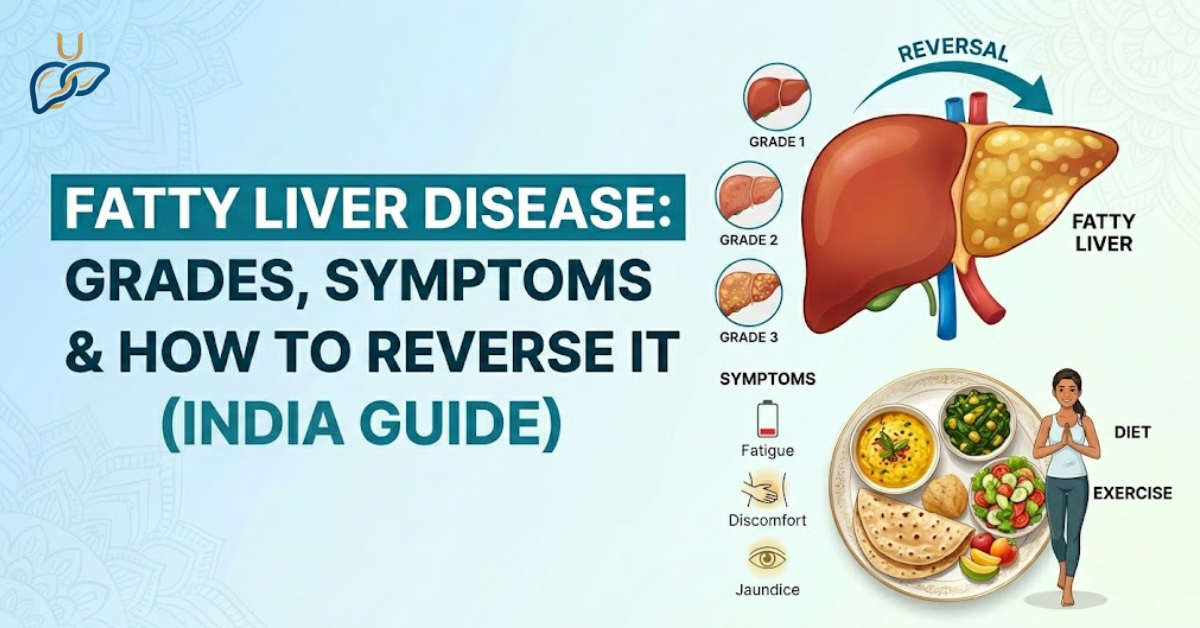
When an ultrasound report says “Grade 1 fatty liver,” many patients do not know whether to worry or not. Here is a plain-English explanation of each grade, what it means clinically, and what the prognosis looks like.
Grade 1 (Mild Fatty Liver)
Fat occupies between 5% and 33% of liver cells. On ultrasound, the liver appears mildly brighter than surrounding tissue (described as “mildly echogenic”). There is no inflammation, no fibrosis. This stage is completely reversible with 3–6 months of sustained dietary changes and regular exercise. Most people with Grade 1 have no symptoms whatsoever.
Grade 2 (Moderate Fatty Liver)
Fat deposits are now present in 33–66% of liver cells. The liver may be mildly enlarged. Some patients begin noticing fatigue or a vague discomfort under the right rib cage. Blood tests may show modestly elevated liver enzymes (SGPT/ALT, SGOT/AST). This stage is still reversible, but requires a more committed and consistent lifestyle intervention, ideally with medical guidance.
Grade 3 (Severe Fatty Liver / NASH Territory)
More than 66% of liver cells carry fat deposits, and inflammation is often present. The liver is typically enlarged. Enzyme levels are significantly elevated. This grade frequently overlaps with NASH — meaning inflammation is actively causing liver cell death. At this stage, reversal is possible but harder, and specialist supervision is strongly recommended. Without intervention, Grade 3 can progress to fibrosis within a few years.
Grade 4 (Cirrhosis)
This is the end-stage of advanced fatty liver disease. Scar tissue (fibrosis) has replaced large portions of healthy liver tissue. The liver loses its regenerative capacity. Grade 4 cannot be fully reversed, though progression can be halted and quality of life can be preserved with the right treatment. Complications including portal hypertension, ascites, jaundice, and an increased risk of hepatocellular carcinoma must be carefully managed by a hepatologist.
7 Warning Signs of Fatty Liver Disease Indians Commonly Miss
Fatty liver is often called a “silent” disease because Grades 1 and 2 rarely cause noticeable symptoms. But the body does send signals — subtle ones that most people attribute to stress, poor sleep, or spicy food. Knowing these warning signs can mean the difference between catching the disease early and discovering it at an advanced stage.
1. Persistent fatigue that rest does not fix. When the liver is under stress, it struggles to process energy substrates efficiently. This results in a deep, ongoing tiredness that feels disproportionate to your activity level.
2. Dull discomfort or heaviness under the right rib cage. The liver sits below your right ribs. As it enlarges under fat accumulation and inflammation, patients often describe a feeling of pressure, fullness, or mild aching in that area — not sharp, but persistent.
3. Bloating and indigestion after meals. An inflamed or enlarged liver can affect bile flow, impairing fat digestion. Many patients notice they feel excessively full, gassy, or uncomfortable after even moderate meals.
4. Unexplained weight gain, particularly around the abdomen. Fat gain around the belly is both a cause and an effect of fatty liver, creating a cycle that worsens over time.
5. Elevated SGPT/ALT or SGOT/AST on a routine blood test. For most Indians, the first sign that something is wrong with the liver comes from a blood report. SGPT (also called ALT) is the most sensitive marker of liver cell stress. Even a mildly elevated reading — say, 45–80 U/L — deserves investigation rather than dismissal.
6. Yellow tinge in the eyes or skin (jaundice). This symptom appears later in disease progression, when the liver can no longer process bilirubin efficiently. Jaundice with known or suspected fatty liver requires immediate specialist evaluation.
7. Spider veins, easy bruising, or itchy skin. These are signs that the liver’s protein synthesis and clotting functions are compromised — features seen in advanced NAFLD or cirrhosis.
How Is Fatty Liver Diagnosed?
Diagnosis involves a combination of clinical history, blood tests, imaging, and — in select cases — a liver biopsy.
Liver Function Tests (LFTs): The standard first step. SGPT (ALT) and SGOT (AST) measure liver enzyme levels. Elevated levels raise suspicion, but normal levels do not rule out fatty liver — even Grade 2 NAFLD can exist with normal enzymes.
Ultrasound Abdomen: The most widely used, affordable, and non-invasive tool for detecting fatty liver. An experienced radiologist can assess liver size, echogenicity (brightness), and texture. Ultrasound reliably detects Grade 2 and Grade 3 fatty liver but may miss Grade 1.
FibroScan (Transient Elastography): A newer, non-invasive test that measures liver stiffness — an indicator of fibrosis — using ultrasound waves. FibroScan is more sensitive than standard ultrasound for detecting early fibrosis and is recommended before considering biopsy.
Liver Biopsy: The gold standard for diagnosing NASH, assessing the degree of inflammation, and staging fibrosis. Biopsy involves inserting a thin needle through the skin into the liver under ultrasound guidance to obtain a small tissue sample. It is recommended when the degree of liver damage is unclear from imaging alone, or when clinical management depends on knowing the exact histological grade. At Umman’s Gastro Health Center Agroha, guided liver biopsies are performed by experienced hepatologists under ultrasound vision for precision and safety.
Can Fatty Liver Be Reversed? Yes — Here Is How
This is the most important question patients ask, and the answer for Grade 1 and Grade 2 disease is a definitive yes. Even Grade 3 NASH can be significantly improved with consistent effort. Research consistently shows that a 7–10% reduction in body weight, combined with dietary modification and regular physical activity, can produce meaningful and measurable improvements in liver fat, inflammation, and fibrosis.
Here is what that looks like in practice for an Indian patient:
1. Dietary Transformation (With Indian Food in Mind)
The goal is not to adopt a “Western” diet. It is to reduce the dietary drivers of liver fat while keeping your food culturally familiar and sustainable.
Drastically reduce refined carbohydrates. White rice eaten in large quantities at every meal is one of the biggest contributors to NAFLD in South Asian populations. This does not mean eliminating rice — it means reducing portion sizes, switching to hand-pounded or parboiled varieties, and pairing rice with vegetables and protein rather than eating it with dal alone.
Eliminate maida from your daily diet. White bread, parathas made from refined flour, biscuits, namkeen, and packaged snacks should be replaced with whole-wheat, bajra, jowar, or ragi alternatives. These complex grains digest more slowly, produce lower blood sugar spikes, and reduce the liver’s fat production signals.
Remove sugary beverages entirely. Packaged juices, cold drinks, nimbu pani with excess sugar, and sweetened lassi are among the most efficient ways to drive liver fat accumulation. Even one glass of commercial fruit juice per day adds enough fructose to significantly worsen fatty liver.
Increase protein at every meal. Dal, eggs, paneer, tofu, moong chilla, and curd are excellent protein sources. Adequate protein preserves muscle mass during weight loss and has been shown to reduce liver fat independent of calorie reduction.
Prioritise vegetables and high-fibre foods. Leafy greens (palak, methi, bathua), cruciferous vegetables (gobhi, broccoli), and whole pulses slow glucose absorption and support healthy bile metabolism. Aim for at least two to three cups of cooked or raw vegetables daily.
Use healthy fats in moderation. Replace dalda and refined sunflower oil with cold-pressed mustard oil, extra virgin olive oil, or pure ghee used sparingly. Avocado, walnuts, and flaxseed are excellent sources of omega-3 fatty acids that actively reduce liver inflammation.
Coffee has evidence behind it. Studies show that two to three cups of regular black coffee per day (without sugar or cream) are associated with reduced liver fat, lower SGPT levels, and reduced fibrosis risk. This applies to filter coffee or black instant coffee — not sugary café beverages.
2. Exercise: What Type and How Much
Physical activity reduces liver fat through two mechanisms: it increases insulin sensitivity (so the liver stores less fat) and it directly burns visceral adipose tissue. Research suggests that at least 150 minutes of moderate-intensity aerobic exercise per week — equivalent to five 30-minute brisk walks — produces significant reductions in liver fat even without weight loss.
Resistance training (bodyweight exercises, weight training, resistance bands) has an independent and additive benefit. Patients who combine aerobic and resistance training show greater improvements in liver enzyme levels than those who do either alone.
For Indian patients who live sedentary lives or have joint issues, starting with 20-minute walks after dinner and gradually building up is a practical and sustainable approach.
3. Medications and Supplements (Under Specialist Supervision)
There is currently no single FDA-approved drug specifically for NAFLD, though several are in late-stage trials. For Grade 2 and Grade 3 disease, doctors may prescribe:
Vitamin E (Tocopherol): High-dose Vitamin E (800 IU/day) has shown benefit in NASH patients without diabetes in multiple trials.
Metformin: For patients with coexisting insulin resistance or type 2 diabetes, metformin improves insulin sensitivity and has indirect benefits for liver health.
GLP-1 receptor agonists (such as semaglutide): These newer diabetes and weight-loss drugs are showing very promising results in NASH trials, with some studies showing fibrosis regression in Grade 3 patients.
Milk thistle (Silymarin): Widely used in India, silymarin has modest anti-inflammatory benefits in liver disease and is generally safe. It is not a substitute for lifestyle change but can be used as adjunct therapy.
All medications for fatty liver must be prescribed by a gastroenterologist or hepatologist after evaluating your grade, comorbidities, and current test results.
At What Stage Should You See a Gastroenterologist?
If you have a Grade 1 finding on ultrasound and no elevated enzymes, you can begin with supervised dietary and lifestyle changes and recheck your LFTs and ultrasound in six months. But you should see a specialist without delay if:
- Your SGPT is more than twice the upper limit of normal (typically above 80 U/L)
- Your ultrasound shows Grade 2 or Grade 3 fatty liver
- You have diabetes, hypertension, or metabolic syndrome alongside fatty liver
- You have not improved on six months of lifestyle changes
- You notice any of the later-stage warning symptoms: jaundice, abdominal swelling, very dark urine, or significant unintended weight loss
- You are above 40 years of age with Grade 1 or Grade 2 fatty liver and have not had a FibroScan to rule out hidden fibrosis
At Gastro Health Center Agroha, our hepatology team provides complete liver assessments including LFTs, abdominal ultrasound, FibroScan, and guided liver biopsy when indicated. Early-stage consultations are available Monday to Saturday, 9 AM to 3 PM, with emergency hepatology available 24/7.
Fatty Liver in Hindi — Common Questions (फैटी लिवर के बारे में)
फैटी लिवर क्या होता है? लिवर (यकृत) में जब जरूरत से ज्यादा चर्बी जमा हो जाती है तो उसे फैटी लिवर कहते हैं। यह अक्सर गलत खान-पान, बैठे-बैठे काम करने वाली दिनचर्या और शुगर की बीमारी की वजह से होता है।
क्या फैटी लिवर ठीक हो सकता है? हाँ, Grade 1 और Grade 2 फैटी लिवर, खाने में बदलाव, व्यायाम, और वजन घटाने से पूरी तरह ठीक हो सकता है।
फैटी लिवर में क्या नहीं खाना चाहिए? मैदे से बनी चीजें, मीठे पेय पदार्थ, पैकेट बंद नाश्ता, सफेद चावल अधिक मात्रा में, और तली हुई चीजें।
डॉक्टर को कब दिखाएं? अगर खून की जांच में SGPT ज्यादा आए, पेट में दाहिनी तरफ दर्द हो, थकान बनी रहे, या आँखें पीली दिखें, तो तुरंत गैस्ट्रो विशेषज्ञ से मिलें।
Frequently Asked Questions (FAQ)
Q: Can fatty liver be completely cured? A: Grade 1 and Grade 2 non-alcoholic fatty liver disease are fully reversible. Studies show that a 7–10% reduction in body weight, combined with a low-carbohydrate diet and regular aerobic exercise, can eliminate liver fat and normalise liver enzyme levels within 3–6 months. Grade 3 NASH can be significantly improved but requires specialist supervision and sometimes medication.
Q: What is a normal SGPT (ALT) level in India? A: The standard reference range for SGPT (ALT) in most Indian laboratories is 7–40 U/L for adults. Some labs set the upper limit at 56 U/L. Values above 40–45 U/L warrant further investigation, particularly if accompanied by fatty liver on ultrasound. A single mildly elevated reading is not a diagnosis — context, trend, and accompanying tests matter.
Q: Is fatty liver dangerous if left untreated? A: In most Grade 1 cases, fatty liver remains stable for years if the causative lifestyle factors are not worsened. However, in patients with diabetes, high triglycerides, or obesity, untreated fatty liver can progress to NASH, fibrosis, and eventually cirrhosis over 5–15 years. Cirrhosis significantly increases the risk of liver failure and liver cancer. Early treatment eliminates this risk almost entirely.
Q: Does fatty liver cause pain? A: Grade 1 fatty liver is typically painless. Grades 2 and 3 can cause a dull ache or feeling of heaviness below the right rib cage, where the liver sits. Sharp or severe pain is uncommon with fatty liver alone and should be evaluated for other causes such as gallstones or pancreatitis.
Q: What foods should be avoided with fatty liver in India? A: Patients with fatty liver should minimise or avoid white rice in large portions, maida-based products (white bread, biscuits, parathas, samosas), packaged snacks, cold drinks and packaged fruit juices, sweets and mithai, and deep-fried foods. Full alcohol avoidance is strongly recommended regardless of the type of fatty liver.
Q: Can a person with normal weight have fatty liver? A: Yes. This is called “lean NAFLD” and is particularly common among Indians. The “thin-fat” Indian phenotype — normal BMI but high visceral fat — means that slim individuals can have significant liver fat. Anyone with elevated liver enzymes or an incidental finding of fatty liver on ultrasound should be evaluated regardless of their body weight.
Q: When is a liver biopsy needed for fatty liver? A: Liver biopsy is recommended when imaging and blood tests cannot determine the degree of fibrosis, when NASH is suspected and the treatment decision depends on knowing the exact histological stage, or when other liver conditions need to be ruled out. It is a safe, minimally invasive day-procedure when performed by an experienced gastroenterologist under ultrasound guidance.
Q: How long does it take to reverse fatty liver with diet? A: Most patients with Grade 1 fatty liver see normalisation of liver enzymes within 8–12 weeks of sustained dietary change and weight loss. Ultrasound evidence of reduced liver fat typically shows improvement at the 3–6 month mark. Grade 2 fatty liver may take 6–12 months of consistent effort to show significant reversal.
About Gastro Health Center Agroha — Umman Healthcare
Umman Healthcare runs Gastro Health Center Agroha, located on the first floor, Block D, Maharaja Agrasen Medical College, Agroha, Hissar, Haryana. Our team of gastroenterologists and hepatologists provides complete digestive and liver care — from routine LFT evaluation and abdominal ultrasound to advanced procedures including FibroScan, guided liver biopsy, ERCP, and laparoscopic hepato-biliary surgery.
Consultations are available Monday to Saturday, 9 AM to 3 PM. Emergency services are available 24 hours.
📞 +91 93505 96296 📧 info@umman.care 🔗 Book an Appointment
This article is for educational purposes. It does not substitute a clinical consultation. If you have been diagnosed with fatty liver disease or have elevated liver enzyme levels, please consult a qualified gastroenterologist for personalised medical advice.