
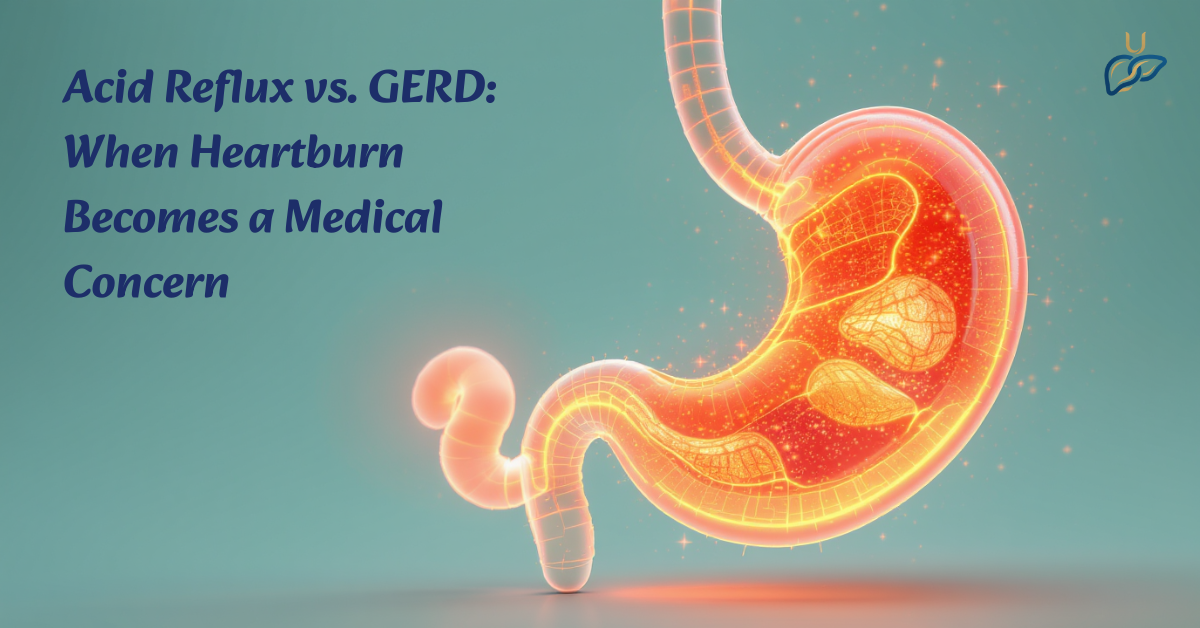
You finish a plate of butter chicken and rice at 11 pm, lie down by 11:30, and by midnight there’s a fire climbing up from your chest into your throat. Sound familiar? For most of us, this is just “gas” or “acidity” – a bottle of antacid, a glass of cold milk, problem solved. But somewhere between “that spicy chaat didn’t agree with me” and “I take an antacid every single day now,” occasional heartburn quietly turns into a disease. Most people never notice the moment it happened.
That’s the whole problem with acid reflux and GERD – they feel identical on any given evening, but they are not the same thing, and treating them the same way can let real damage build up in your esophagus for years before anyone catches it.
Heartburn, Acid Reflux, and GERD Are Not Three Words for the Same Thing
Let’s untangle the vocabulary first, because most confusion starts here.
Heartburn is a symptom – a burning sensation behind your breastbone or in your throat. It has nothing to do with your heart; it’s named for where you feel it.
Acid reflux (also called GER, or gastroesophageal reflux) is the mechanical event that causes heartburn: stomach acid escapes upward into your esophagus because the ring of muscle guarding the entrance to your stomach – the lower esophageal sphincter (LES) – relaxes or weakens at the wrong moment. This happens to almost everyone occasionally, especially after a heavy, oily, or late meal. On its own, it’s not a diagnosis. It’s biology doing what biology does when you eat two samosas standing up and then go straight to bed.
GERD (gastroesophageal reflux disease) is what you call it when this “occasional” event stops being occasional. The generally accepted clinical marker is reflux symptoms occurring two or more times a week, or reflux that’s already causing visible damage to the esophagus regardless of how often it happens. GERD isn’t a worse flavour of heartburn – it’s a chronic condition where the esophagus is being repeatedly bathed in acid it was never built to handle.
Think of it like this: acid reflux is rain. Everyone gets rained on sometimes. GERD is what happens when it rains inside your house every other day and the ceiling starts to give way.
So How Do You Know Which One You Have?
There’s no single home test, but the pattern of your symptoms tells most of the story.
Probably just acid reflux if:
- It happens after specific triggers – a heavy dinner, alcohol, a very spicy meal, lying down too soon
- An antacid or a glass of water sorts it out within the hour
- It’s genuinely occasional – once every few weeks, not every few days
- You feel completely normal in between episodes
Possibly GERD if:
- You’re reaching for an antacid two or more times a week, and it’s become routine rather than a rescue
- The burning wakes you up at night or is worse the moment you lie down
- You regularly taste sour or bitter fluid at the back of your throat, even without eating anything recently
- You’ve started avoiding foods you used to enjoy, “just in case”
- Plain heartburn has been joined by a sore throat, hoarseness, a nagging dry cough, or a feeling that food is sitting halfway down your chest
If you’re nodding along to the second list, it’s worth an actual conversation with a doctor rather than a bigger bottle of antacid.
The Indian Diet Angle: Why We See So Much of This
If you feel like acidity is everywhere around you – your father takes an antacid daily, your colleague swears by jeera water, your neighbour won’t touch onion after 8 pm – you’re not imagining it. Several community studies across Indian cities have found GERD in roughly one in five adults, with numbers running anywhere from about 15% to over 30% depending on the region and population studied, and research from Kashmir, Punjab, and southern India consistently points to the same culprits.
A few habits show up again and again in this research, and most of us will recognise every one of them:
- Late, heavy dinners. Eating a large meal and then lying down within two to three hours gives your stomach no time to empty before gravity starts working against you. Studies on dinner timing have linked eating close to bedtime with more overnight acid exposure and worse next-morning symptoms – this is basically the scientific explanation for why a 10:30 pm thali feels fine going down and terrible by 1 am.
- Fried and high-fat food. Pakoras, parathas, and anything deep-fried relax the LES and slow stomach emptying – a double hit that makes reflux more likely.
- Spice tolerance, not spice itself. The research is more nuanced than “spicy food causes GERD.” For people who already have reflux, chilli and very spicy dishes reliably worsen symptoms and irritate an esophagus that’s already inflamed. It’s less a universal cause and more a trigger that turns up the volume on existing acid exposure.
- Chai, coffee, and tobacco. Caffeine and tobacco both relax the LES; studies from Indian populations have specifically flagged tea/coffee intake and tobacco use as independent risk factors.
- Eating out and skipping meals. Irregular eating patterns – common among students and working professionals – have shown up in multiple Indian surveys as linked to higher GERD rates, alongside low physical activity and rising BMI.
- Sitting or lying down right after a meal. Postprandial posture (literally, what you do right after eating) is one of the most consistently reported risk factors in Indian studies – and also one of the easiest to fix.
None of this means you need to give up your favourite food forever. It means timing and portion often matter more than the dish itself – a smaller thali at 7:30 pm sits very differently than a large one at 10:30 pm, even if the ingredients are identical.
Red Flags: When Heartburn Stops Being a Diet Problem
This is the part worth reading twice, because these are the symptoms that separate “manage it at home” from “get it checked, soon.” Doctors sometimes call these alarm symptoms, and they warrant a gastroenterologist’s attention regardless of how often your reflux happens:
- Difficulty or pain swallowing (food feels like it’s catching or sticking on the way down)
- Unintentional weight loss
- Persistent vomiting, or vomiting blood, or anything that looks like coffee grounds
- Black or tarry stools, or visible blood in stool – signs of bleeding higher up in the digestive tract
- Unexplained anaemia picked up on a routine blood test
- Chest pain, especially if you’re over 40, have risk factors for heart disease, or the pain radiates to your arm or jaw – this needs urgent evaluation to rule out a cardiac cause before anyone assumes it’s “just acidity”
- A cough, hoarseness, or throat clearing that won’t go away, particularly if it’s worse at night
- Symptoms that keep coming back despite regular antacids or a full course of prescribed medication
None of these mean panic. They mean this has moved beyond a lifestyle issue and needs a proper look – usually an upper endoscopy – to see what’s actually happening inside the esophagus.
What Untreated GERD Can Quietly Lead To
The reason doctors take chronic reflux seriously isn’t the discomfort – it’s what repeated acid exposure does to esophageal tissue over years:
- Esophagitis – inflammation and irritation of the esophageal lining, sometimes with ulcers
- Esophageal stricture – scar tissue narrows the esophagus, making swallowing genuinely difficult
- Barrett’s esophagus – a change in the cells lining the esophagus caused by long-term acid damage, considered a precancerous condition that needs monitoring
- A small but real increased risk of esophageal cancer in long-standing, untreated GERD
This progression typically takes years, not weeks, and it’s very much preventable – which is exactly why catching GERD early, rather than self-medicating indefinitely, matters.
When Should You See a Gastroenterologist?
A simple rule of thumb: if you’re treating your own heartburn with over-the-counter antacids two or more times a week, or you’ve been doing this on and off for months, it’s time to see a specialist rather than a pharmacist.
A gastroenterologist can:
- Take a detailed history of your symptoms, diet, and triggers
- Perform an upper endoscopy if needed, to directly examine your esophagus and stomach lining
- Check for complications like esophagitis, strictures, or Barrett’s esophagus
- Build an actual treatment plan – which might be lifestyle changes, acid-reducing medication, or in select chronic cases, a procedure – rather than “take this tablet and see how it goes”
If you’re in Hisar, Agroha, or anywhere nearby in Haryana and this list has felt a little too familiar, GasTRO CENTER’s team can evaluate your symptoms properly and figure out whether you’re dealing with everyday acidity or something that needs ongoing management – before it becomes a bigger problem than a burning chest after dinner.
Simple Changes That Genuinely Help
While you’re deciding whether to book that appointment, these are the changes backed most consistently by research and clinical guidance:
- Leave a 3-hour gap between your last meal and lying down.
- Eat dinner earlier and lighter – even shifting your meal 30–45 minutes earlier can measurably reduce nighttime symptoms.
- Elevate the head of your bed by a few inches, rather than just stacking pillows.
- Sleep on your left side, which research suggests reduces reflux compared to sleeping on your right.
- Cut back on fried food, excess tea/coffee, and tobacco – all proven LES-relaxers.
- Watch your portions, not just your ingredients – a smaller serving of the same spicy dish is often completely fine.
- Maintain a healthy weight – excess abdominal weight is one of the most consistent GERD risk factors across every population studied, Indian included.
FAQs
1. Is acid reflux the same as GERD?
No. Acid reflux is the occasional backward flow of stomach acid that most people experience now and then. GERD is the chronic version – reflux happening two or more times a week, or reflux that’s already damaging the esophagus, regardless of frequency.
2. Can spicy food alone cause GERD?
Not on its own for most healthy people. Spicy food is a trigger that worsens symptoms in people who already have reflux or GERD, rather than a standalone cause. Timing, portion size, and what you eat with the spice (fried vs. not, late vs. early) tend to matter just as much.
3. How do I know if my heartburn needs a doctor’s visit?
If you’re using antacids two or more times a week, symptoms are disturbing your sleep, or you notice difficulty swallowing, unexplained weight loss, vomiting blood, or black stools, see a gastroenterologist rather than continuing self-medication.
4. Can GERD be cured completely, or only managed?
For most people, GERD is managed rather than “cured” – through lifestyle changes and medication that control symptoms and prevent esophageal damage. Some cases with an anatomical cause (like a hiatal hernia) may benefit from a procedure. A gastroenterologist can tell you which category you fall into after an evaluation.
5. Is chest pain from GERD ever dangerous?
GERD-related chest pain is not itself dangerous, but it can closely mimic heart-related chest pain. If you’re over 40, have heart disease risk factors, or the pain spreads to your arm, jaw, or back, treat it as an emergency and get it checked immediately rather than assuming it’s acidity.
6. Does drinking milk help with acid reflux?
Milk can offer brief, temporary relief by coating the esophagus, but full-fat milk can also stimulate more acid production shortly after, so it’s not a reliable long-term fix – especially for frequent symptoms.
7. Can GERD cause problems outside the stomach, like cough or throat issues?
Yes. Chronic acid exposure can travel up into the throat and airways, contributing to a persistent dry cough, hoarseness, sore throat, and even asthma-like symptoms – often worse at night. This is one of the reasons GERD sometimes gets missed for months, since it doesn’t always look like a digestive problem.
References
- Mayo Clinic – Acid reflux and GERD: The same thing?
- National Institute of Diabetes and Digestive and Kidney Diseases (NIDDK) – Definition & Facts for GER & GERD
- Cleveland Clinic – Acid Reflux & GERD
- NIH MedlinePlus Magazine – Acid reflux, Heartburn, and GERD: What’s the difference?
- Franciscan Health – The Difference Between Acid Reflux and GERD
- Cooper University Health Care – The Stages of GERD
- Prevalence and risk factors of GERD in a community-based population in southern India – BMC Gastroenterology
- Prevalence and risk factors of GERD in Kashmiri population – International Journal of Pharmacy and Pharmaceutical Sciences
- Prevalence and risk factors for GERD in the Indian population: A meta-analysis – PubMed
- Prevalence and risk factors of GERD at a tertiary care center of Central India – International Journal of Health and Clinical Research
This article is for general informational purposes and isn’t a substitute for personalised medical advice. If your symptoms match the red flags above, please consult a gastroenterologist directly.